
East Brunswick Previous Residents by Era
Start a backward address trail by choosing the source that fits the date. The online land-record index is strong for modern recorded conveyances. Earlier deeds, books, and indexes require a county record-room or archive path. Regional New Brunswick directories supply published household snapshots, but they are not a verified standalone East Brunswick directory run. Probate, newspapers, museum material, and the State Archives can then help test household connections when an ownership record alone is not enough.
| Source | Years it covers | Where held | What it shows |
|---|---|---|---|
| Middlesex deed index | Deeds 1929 forward online | County Clerk portal and record room | Recorded parties, instruments, dates, book and page references |
| County archival deeds and indexes | Deeds 1784-1901; indexes 1784-1922 | County archival and record-series routes | Earlier legal descriptions and transfer leads |
| New Brunswick regional directories | Located runs 1855-1981 | New Jersey State Library catalog and physical holdings | Published address, route, and household listings |
| Appleby-DeVoe local history material | Collection-specific dates vary | East Brunswick Museum by appointment | Photographs, property and family context, correspondence |
| Probate and newspapers | Record-specific coverage | Surrogate, newspaper resources, and Archives | Heirs, executors, relatives, locations, and dates to verify |
For a property with a recent deed, begin there. For an early address, begin with the legal description or block and lot, then use regional directories and archival series to bridge back. The phrase “past residents” should be reserved for evidence of a household at a place, not merely a person whose name appears in a related instrument.
Fix the East Brunswick Address Key
Before searching older names, capture the property location, block, lot, qualifier, PAMS PIN, deed book and page, postal city, and any historic street spelling. The assessment hub, the municipal assessor, and county GIS contribute different parts of that identity. GIS property location is the situs, while OwnerAddr1, OwnerAddr2, and ZipCode are mailing fields. A deed’s legal description is the stronger land identifier when a street string has changed or a nearby postal label appears on a document.
Use the Middlesex County parcel layer as the current map check. It can display parcel geometry, block and lot, sales date, deed book and page, acreage, value, land description, and related fields. The service updates monthly with municipal MOD-IV updates. It is useful for setting a modern starting point, but it does not recreate an earlier parcel layout and it is not a legal survey.
- Grantor
- The person or entity that conveys or gives an interest in a recorded document.
- Grantee
- The person or entity that receives the recorded interest.
- Chain of title
- The sequence of recorded transfers or interests followed through linked legal documents.
- Legal description
- The written or mapped land identity, such as a block and lot, used to match a parcel despite street-address changes.
Trace East Brunswick Previous Residents in Deeds
The Middlesex County Clerk index is a transfer trail, not a census of occupants. Search by Town set to East Brunswick plus block and lot, legal description, parcel ID, map number, current party, or an address string if Property mode accepts the spelling. Party Name uses a last-first format and also accepts company names. Record every document’s instrument number, type, recorded date and time, book and page, consideration, legal lines, party role, and references before drawing a connection between two names.
- Use the assessor or GIS record to capture today’s block, lot, PAMS PIN, situs spelling, and deed book and page.
- Search the Middlesex land-record index by town and the most stable legal identifier, then open the indexed record if access is available.
- Identify the document type and the current grantee. A deed conveys an interest; a mortgage, lien, easement, release, or power of attorney serves a different purpose.
- Use the prior reference or seller’s earlier acquisition to locate the next deed in the chain, comparing legal descriptions at every step.
- When the path reaches the web boundary, use the record room, county archival series, written-request route, or a State Library and locality-guide lead for older records.
A recorded deed can establish a recorded conveyance or other interest. It cannot, by itself, establish when a family moved in, how long it stayed, or whether a party was a trustee, executor, attorney, lienholder, or resident. Pair the legal chain with a directory, census geography, probate, or newspaper source before calling someone a past household member.
East Brunswick Previous Residents Before 1929
The online index does not cover every era equally. Middlesex provides deeds from 1929 forward online, mortgages from 1950 forward, and other documents from 1958 forward. A 2022 county release says public deeds were digitized from the 1950s back to 1923, while work continued. The locality guide describes older deed series from 1784 to 1901 and deed indexes from 1784 to 1922. County land records on file reach much farther back than the public web index, so an online no-result is not an end point.
The Registry of Deeds public record room is in the County Administration Building at 75 Bayard Street in New Brunswick. It is open Monday through Friday, 8:30 a.m. to 4:10 p.m., with arrival by 4:00 p.m. Staff can familiarize visitors with computerized indexing but do not perform title searches. For a stored or restricted county document, the Archives and Records Management guidance directs researchers to the office that maintains the originating record rather than treating the archives as a single uniform counter.
This date mismatch is a Profile 1 numbers finding. State the series, the date range, and the access channel beside every result. It prevents a missing web entry from being mislabeled as a missing previous resident.
Pair East Brunswick Directory Dates
A published directory answers a narrower question than a deed. It can show that a surname, given name or initial, street or rural route, postal place, occupation or business descriptor, household notation, or cross-reference appeared in a particular publication. A reverse or criss-cross directory starts with the street or address, while an alphabetic directory starts with the surname. The regional New Brunswick runs include 1855, 1870, 1886, 1890, 1897, 1899, 1901 through 1908, 1921 through 1924, 1930 through 1946, 1954, 1962 through 1968, and 1970 through 1981.
- Choose a directory issue close to the target date and transcribe its original street, route, postal place, spelling, and page reference.
- Check a reverse or criss-cross arrangement if a physical volume offers one, then compare the address with the alphabetic listing.
- Match the directory time point to census geography and note the evidence date separately from the deed-recording date.
- Use probate, newspaper, tax, and land records to test the same household, especially where surname spelling changes.
The collections, publishers, and catalog limits are described on the East Brunswick city directory page. Regional scope matters. No complete independent East Brunswick city-directory run or final print year was verified, so a New Brunswick or nearby-community listing should be treated as a lead to compare, not a conclusive local match.
East Brunswick House History Sources
The official New Jersey house-history guide supports a layered approach: identify the property, work through deeds and maps, use directories and archival research, and distinguish a source lead from proof.  That approach fits East Brunswick because the address, legal description, postal label, and former township context can differ from one record to the next.
East Brunswick Museum’s Appleby-DeVoe Library is a local-history reference archive reached by appointment. The DeVoe property was presented to the township in 1945, opened as a library in 1946, served as a public-library branch from 1966 to 1981, and has been leased to the museum since 1999. Its material includes photographs of homes and places, family and property material, Governor Hoffman correspondence, Lindbergh-trial transcripts, artifacts, and pottery and brickmaking context. Ask for provenance, date, creator, and collection reference before using a photograph or local story to support an address conclusion.
The Appleby family’s “Doctor’s lot” material is a useful local story, not a substitute for a certified deed abstract. It can suggest a research route through the museum’s source notes, followed by the Clerk’s legal chain. Keeping those sources separate preserves the distinction between a family-history narrative and a recorded transfer.
East Brunswick Historic Archive Routes
The New Jersey State Archives search entry is an additional path for older research when county online coverage stops. 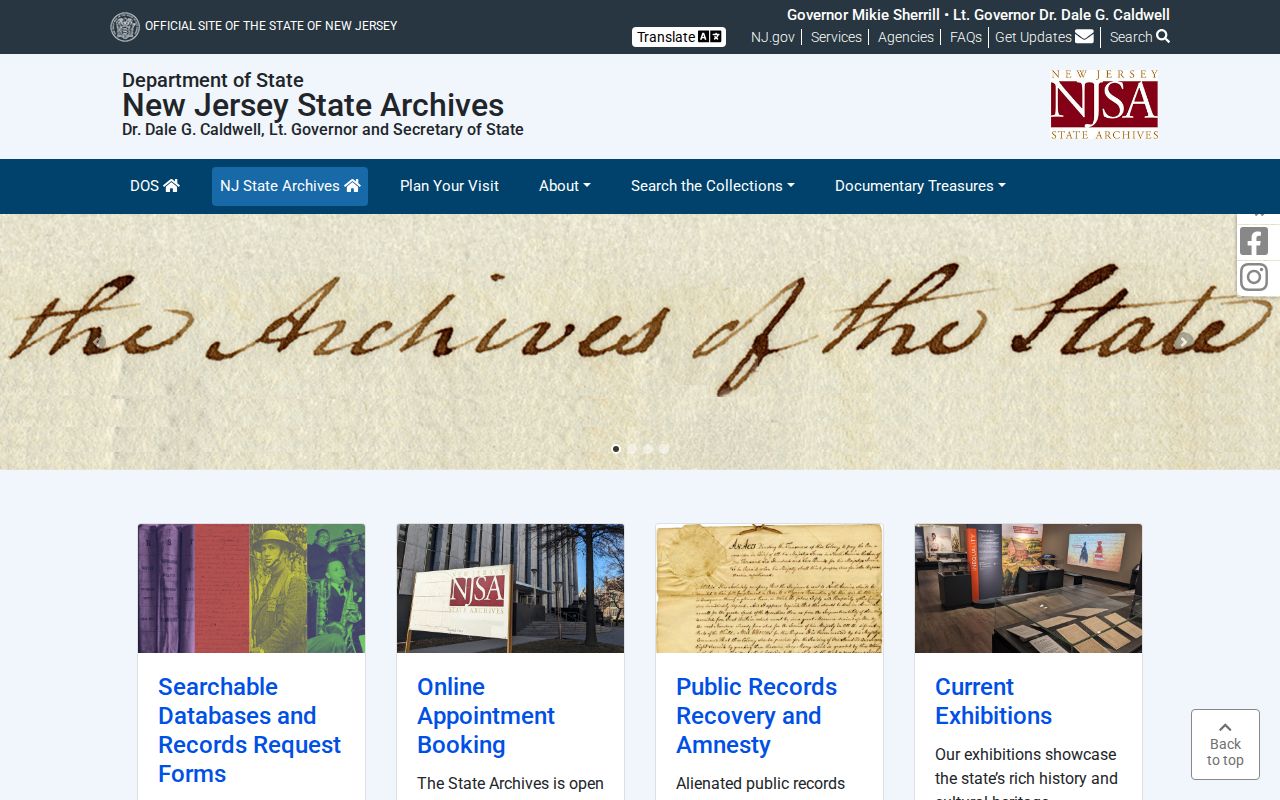 State Archives material includes court files, naturalization, marriages, name changes, newspapers, and other county and state series. Access is free for public research, subject to appointment or walk-in conditions based on space, and copies or reproductions can cost extra.
Middlesex naturalization records offer a focused bridge for a historical household: records from 1926 through 1958 are searchable or downloadable through the county portal with code PETNAT. For county coverage from 1806 through 1991 outside that searchable span, use a written county request. The State Archives serves an older 1794 through 1906 petitions and declarations collection. A naturalization record can hold a name, arrival, residence, occupation, witnesses, and date, but those details still need comparison with the address trail.
East Brunswick Past Residents and Probate
Probate is often a strong bridge between an address and a family. The Middlesex Surrogate route covers wills, estate searches, guardianships, and related records. A probate file can identify executors, heirs, witnesses, property, and relationships, which can help distinguish same-name people found in a deed or directory. The official Surrogate Search portal is a starting point, while guardianships and sealed matters require the Surrogate. The research capture did not verify the portal’s full live fields, so searches should not be described as a fixed public form.
Newspapers and obituaries can add relatives, a former address, a funeral-home reference, or a date. The New Jersey State Library’s digitized-newspaper guide identifies Middlesex County resources, including New Brunswick Free Public Library, Cranbury, Metuchen, South Amboy, South Brunswick, and South Plainfield holdings. An obituary remains a report to check against probate or vital material. Do not republish sensitive details about living people merely because a historical notice is available.
Historic East Brunswick Address Names
East Brunswick incorporated in 1860, and Helmetta, South River, Spotswood, and Milltown withdrew between 1870 and 1908. Old Bridge is part of the township’s historic story and also a neighboring municipal and postal label. A prior household may therefore be listed under a former section, a rural route, or a nearby post office rather than a modern East Brunswick form. Preserve the original phrase before checking the deed legal description, parcel map, and municipality lookup.
Riva Avenue, Farrington Lake, rail and waterway references, pottery, brickmaking, and former rural routes can all be useful search terms in maps, newspapers, museum material, deeds, and directories. They supply place context, not identity proof. A clear research trail states whether a person was “listed at,” “appears in,” or “recorded as” an address, and saves a stronger claim for evidence that directly supports it.
Past Households in East Brunswick Records
Ownership and occupancy are separate questions. A current or historic deed may identify a recorded party, while a regional directory provides a dated household listing. Census geography, probate, newspapers, and local-history records can support or challenge the connection. In East Brunswick, the safest wording is evidence-based: “listed at the address in a directory year,” “recorded as a party to a deed,” or “named in a probate record.” That approach is especially important where a trust, estate, company, executor, or mailing address appears in the land records.
Past-resident research is also constrained by protected information. Daniel’s Law can limit display of home addresses and unpublished phone numbers for covered people, and the Address Confidentiality Program gives eligible participants a legal substitute address for future records. A missing address is not evidence that a record does not exist. Public material should be used to understand a property’s history, connect family records, or verify a documented lead, never to target a living person.
Lawful use. East Brunswick previous-resident research supports house history and family history; never use records to stalk, harass, or harm another person.