
Finding East Brunswick Residents
East Brunswick does not keep one master resident roll. The township assessor keeps property material, Middlesex County keeps land and parcel tools, New Jersey keeps voter-status and vital-record channels, and the courts keep category-based case indexes. Each source answers a smaller question. A tax record can offer an owner or parcel lead. A recorded instrument can establish that a party had a documented role in a transfer. Neither one, by itself, proves that a person lives at an address today.
Begin with the strongest detail already known. For a present address, use the property path. For one person, normalize the full name and test former or hyphenated forms before treating a no-match as an answer. For an earlier household, start near the target year in a regional directory, then use land, probate, newspaper, or Archives material to test the lead. Keep the source date with every result, because a current East Brunswick record and a historical directory entry describe different moments.
- Search the Middlesex assessment hub by property, owner name, or block-lot-qualifier, then keep the parcel details that distinguish one property from another.
- Use the county GIS layer to compare the situs location, block, lot, parcel identifier, mailing fields, and deed references where present.
- Run the County Clerk land-record index with East Brunswick plus a party name, instrument, book/page, legal description, or block and lot.
- Check the state voter-status tool with the legal name and Middlesex County, remembering that it is an individual status check rather than a bulk directory.
- For a missing or older record, contact the proper custodian, library, Archives, or records-request channel with a narrow date span and description.
Note: A same-name result becomes useful only after a parcel, date, middle name, family connection, or legal description supports the match.
East Brunswick Resident Records Offices
The main East Brunswick resident records route is split between the Civic Center, the Middlesex County complex in New Brunswick, and the county election offices in East Brunswick. The Township Tax Assessor handles municipal tax maps, ownership records, sales, descriptions, and property information. The County Clerk’s Registry of Deeds keeps recorded instruments. County election offices handle distinct election functions, while the state supplies the public voter-status tool. Ask each office for the record it actually keeps rather than sending every question to the municipal clerk.
Middlesex County Clerk
Registry of Deeds and Land Records
75 Bayard Street, 4th Floor
New Brunswick, NJ 08901
732-745-3002
East Brunswick Tax Assessor
1 Jean Walling Civic Center Drive
East Brunswick, NJ 08816
732-390-6845
Middlesex County Elections
26-B Kennedy Boulevard, Suite B
East Brunswick, NJ 08816
732-745-4202
The Clerk’s public record room is open Monday through Friday, 8:30 a.m. to 4:10 p.m., with arrival by 4:00 p.m. The office can help a visitor use the computerized index, but it does not perform a title search. The assessor is open Monday through Friday, 8:30 a.m. to 4:30 p.m. Its in-person property material is the fallback when a web result does not resolve a parcel question.
East Brunswick Parcel Records First
Property research works best when the address is converted into a parcel key before a person is searched. The assessment hub can filter by Town, Owner Name, Property, B.L.Q., property class, sales date, sale-price range, building-square-foot range, and year-built range. Set the town to East Brunswick, test spelling variants with the portal’s wildcard rules, and preserve the returned parcel context. The hub offers an owner lead, but its current data is not a residency statement.
| Assessment-hub field | Format | How it helps an East Brunswick search |
|---|---|---|
| Town Filter | Municipality selection | Limits a countywide query to East Brunswick. |
| Owner Name | Text, with * and ? wildcards | Tests a surname, initials, or spelling variant. |
| Property | Address or property text | Starts from a known street address. |
| B.L.Q. Filter | Block, lot, qualifier | Matches the legal parcel key across systems. |
| Sales and building filters | Date, range, or category filters | Narrows a broad parcel result without identifying a resident. |
The county GIS parcel service then supplies a geographic check. Its visible fields include PAMS_PIN, municipality, block, lot, property location, mailing-address lines, ZIP, deed book/page, sale information, acreage, building data, and geometry. A property location, also called a situs, is the physical parcel address. Mailing fields can point somewhere else. The visible GIS field list does not expose a general owner-name field even though the service has an OwnersName display alias, and Daniel’s Law can affect visibility.
- Parcel
- A defined piece of land used in assessment and mapping systems.
- Block and lot
- The local legal identifiers used to distinguish one parcel from another.
- Situs
- The physical property location, which can differ from an owner’s mailing address.
- Roll
- An official list maintained for a particular purpose, such as assessment or registration, not a complete roster of everyone in town.
For an address-by-address chain, the East Brunswick street directory keeps the fuller assessor, GIS, and deed workflow in one place.
East Brunswick Deed Index Dates
Middlesex County’s land index is a party-and-document system, not an occupancy list. Its online coverage begins with deeds from 1929 forward, mortgages from 1950 forward, and other documents from 1958 forward. A 2022 county digitization release reported public deeds reaching back into the 1920s. For earlier work, the county record room, written-copy route, Archives, and locality guides remain important. County land records on file reach much further back, so an online no-match can simply mark the end of the current portal’s range.
Use Party Name in last-name first-name form, choose Town as East Brunswick where appropriate, and then narrow by document type, date, consideration, instrument number, book/page, lot/block, legal description, map number, or parcel ID. An index result may show party roles, document type, instrument number, recording date and time, book/page, consideration, legal-description lines, map or parcel data, notes, and linked documents. Some images are restricted, absent, or require an account, payment, or in-person inspection.
A grantor is the party transferring an interest. A grantee is the party receiving it. Those roles establish a recorded transaction, not a move-in date. Trustees, executors, lien parties, attorneys, and companies can appear in the same search. Compare the legal description and parcel details before using a deed as an East Brunswick resident lead.
Note: The County Clerk’s online system is normally listed as available 5:00 a.m. to 11:00 p.m., subject to maintenance.
East Brunswick Voter Status Carefully
New Jersey’s “Am I Registered?” service is an individual status check, not a public East Brunswick residents directory by street. The state advises using the name exactly as it appears in the county registration record. Hyphenation, spaces, maiden or former names, middle initials, and nicknames can all change a result. A no-match can therefore mean a spelling issue, a changed name, an inactive status, redaction, or nonregistration, rather than a final conclusion about a person.
New Jersey’s statewide voter system contains many statutory fields, but that does not mean each field is shown in a public result. The live public form was dynamic when researched, so its current labels, verifier behavior, and displayed fields should be checked in the browser before relying on a result. For a permitted voter-list request, the county commissioner of registration has a separate statutory route. Signatures are excluded, and covered-person home addresses can be redacted.
County Clerk Elections is at 26-B Kennedy Boulevard, Suite B, and the Board of Elections is at 26 Kennedy Boulevard, Suite B, both in East Brunswick. Use the Clerk for clerk-managed election records and the Board for registration, ballot, counting, and election-administration questions. A sample ballot can provide district and contest context, but it is not a resident roster.
Current East Brunswick Residents Directory Sources
Current East Brunswick resident directories are really separate official rolls and institution-level listings. Start with the source that matches the question. The assessor and assessment hub are useful for a property relationship. The County Clerk index is useful for a recorded instrument. The voter portal checks an individual registration status. Community and municipal pages document public organizations, boards, and contacts, not private membership lists. Treat every result as a defined record type with an access limit.
| East Brunswick source | What it may establish | Custodian | Access route |
|---|---|---|---|
| Tax maps and ownership records | Property and assessment lead | East Brunswick Tax Assessor | Office and county search hub |
| Parcel layer | Block, lot, situs, mailing, deed and map context | Middlesex County GIS | Current public map/query service |
| Land-record index | Recorded parties and document details | Middlesex County Clerk | Online index, record room, copy route |
| Voter status | Individual registration-status result | New Jersey and county election offices | Exact-name public lookup or controlled request |
| Community-service and board pages | Public organization and civic-document contacts | East Brunswick Township | Township directory pages and records channels |
The commercial people-search category can be fast but is not a custodian record and may carry stale, mixed, or incomplete information. Official rolls often require a narrower question, yet they identify the keeper and the record’s meaning. Use a record room, form, or written request when the official channel is not online rather than filling a gap with a loosely matched profile.
| Official record route | Commercial people-search category |
|---|---|
| Names the governmental or institutional custodian and shows the record type. | May combine sources without showing a complete provenance trail. |
| Usually has defined access limits, dates, and correction channels. | Can retain old associations or combine people with similar names. |
| Supports a focused personal, family-history, estate, safety, or civic question. | Still needs confirmation against the office that holds the source record. |
East Brunswick Court Record Categories
New Jersey Courts separates public case research by category. The state’s Find a Case entry routes to civil and foreclosure, criminal, criminal judgments, judgment liens, Tax Court, and municipal searches. An East Brunswick name can appear in different systems for different reasons, so choose the category before treating a case index as a lead. A docket is the court’s case record and event list. A party name alone does not establish identity, guilt, liability, or a current address.
See the New Jersey Courts case-search entry before selecting a category.
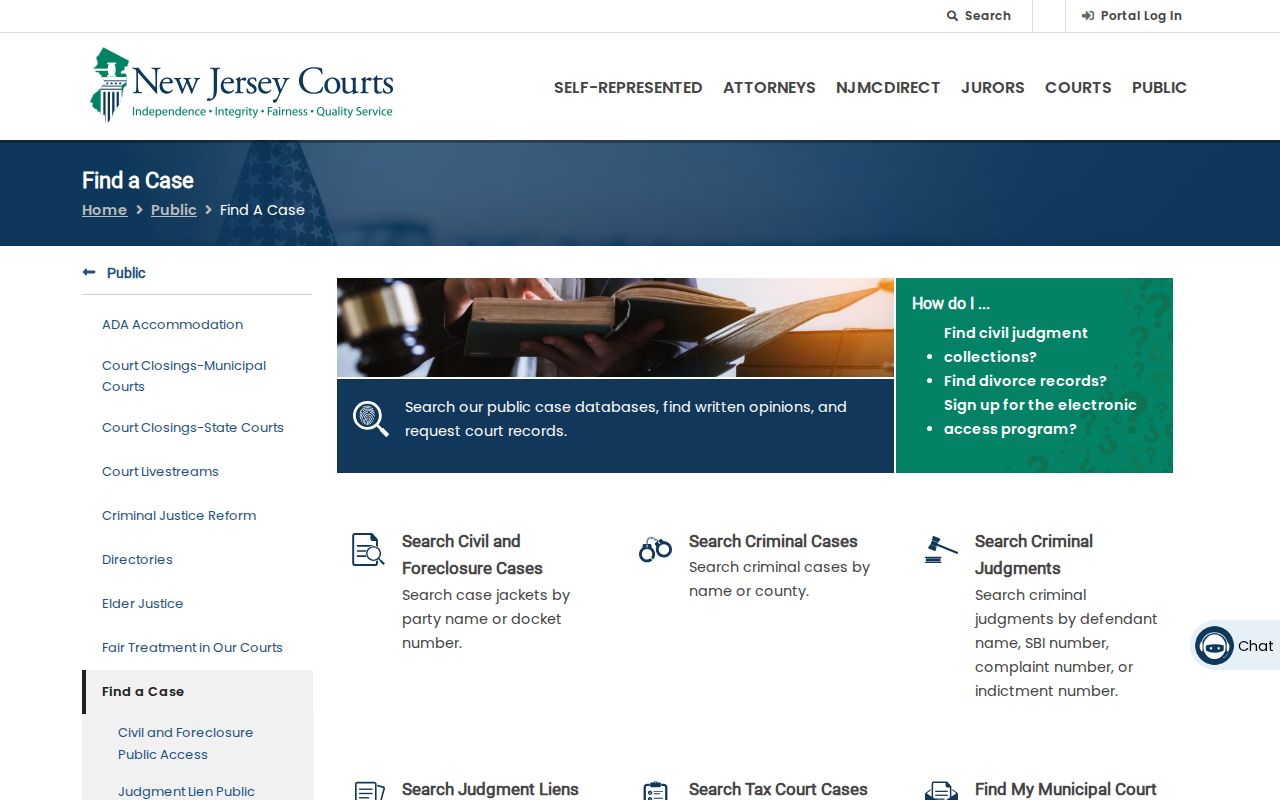
The category screen is a useful reminder that civil, criminal, judgment, tax, and municipal records have different scopes and privacy rules.
East Brunswick Municipal Court is at 1 Jean Walling Civic Center Drive. Its virtual-registration form is for an appearance and requires defendant first and last name, phone, email, and case, complaint, or ticket number. It is not a full public case-file search. Public copies follow Judiciary procedures, and protected categories can include juvenile, sealed, expunged, adoption, confidential family, and victim material.
Use the Judiciary’s copy-request instructions for the available request routes and fee schedule.
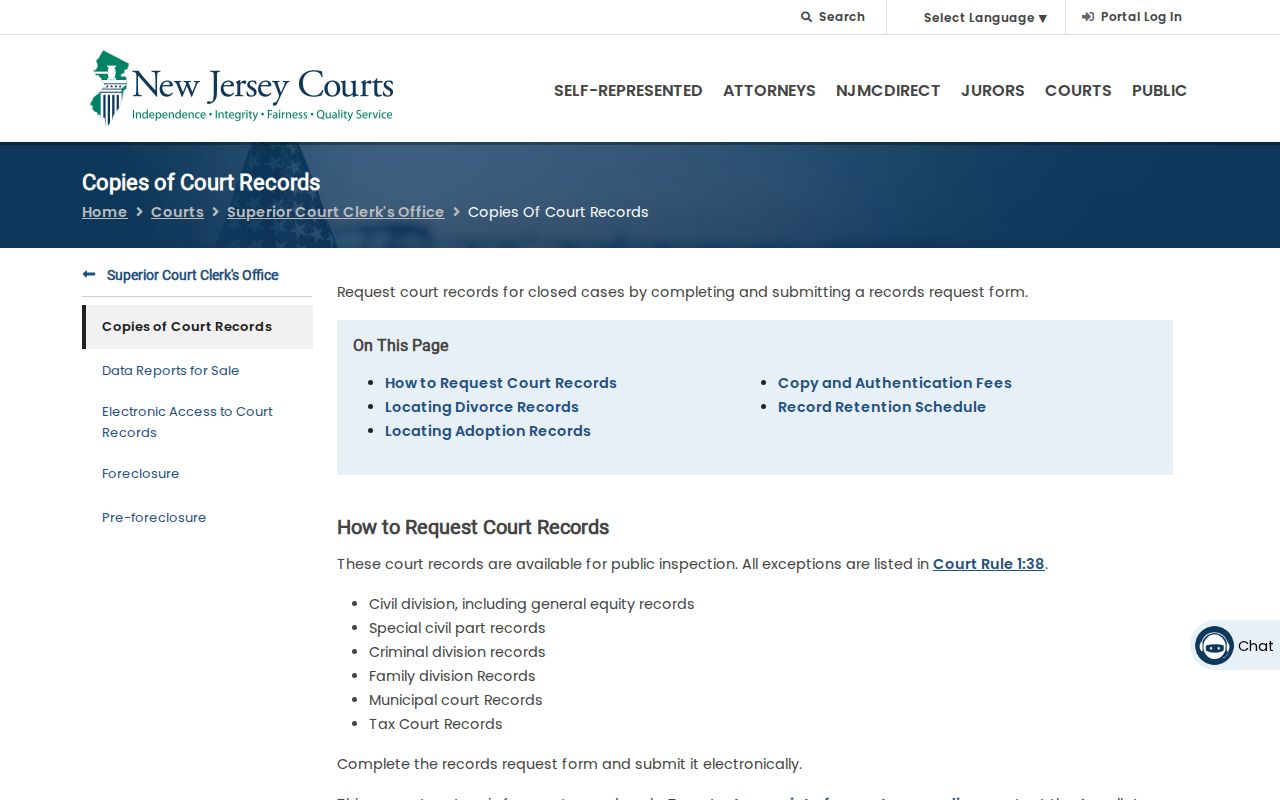
For a result that matches a name, compare court, case type, docket number, filing date, status, and disposition before treating it as the same East Brunswick person.
East Brunswick Vital Record Routes
Vital records are a controlled-copy path, not an open name search. New Jersey genealogy rules require a birth record to be more than 80 years old, a marriage record more than 50 years old, and a death record more than 40 years old, with the deceased-person condition where applicable. The request uses the person’s full name, city or county, and year; an exact date, parental names, and a death SSN are optional only where known. ID and eligibility rules still apply.
See the New Jersey genealogical-record request information before preparing REG-28.
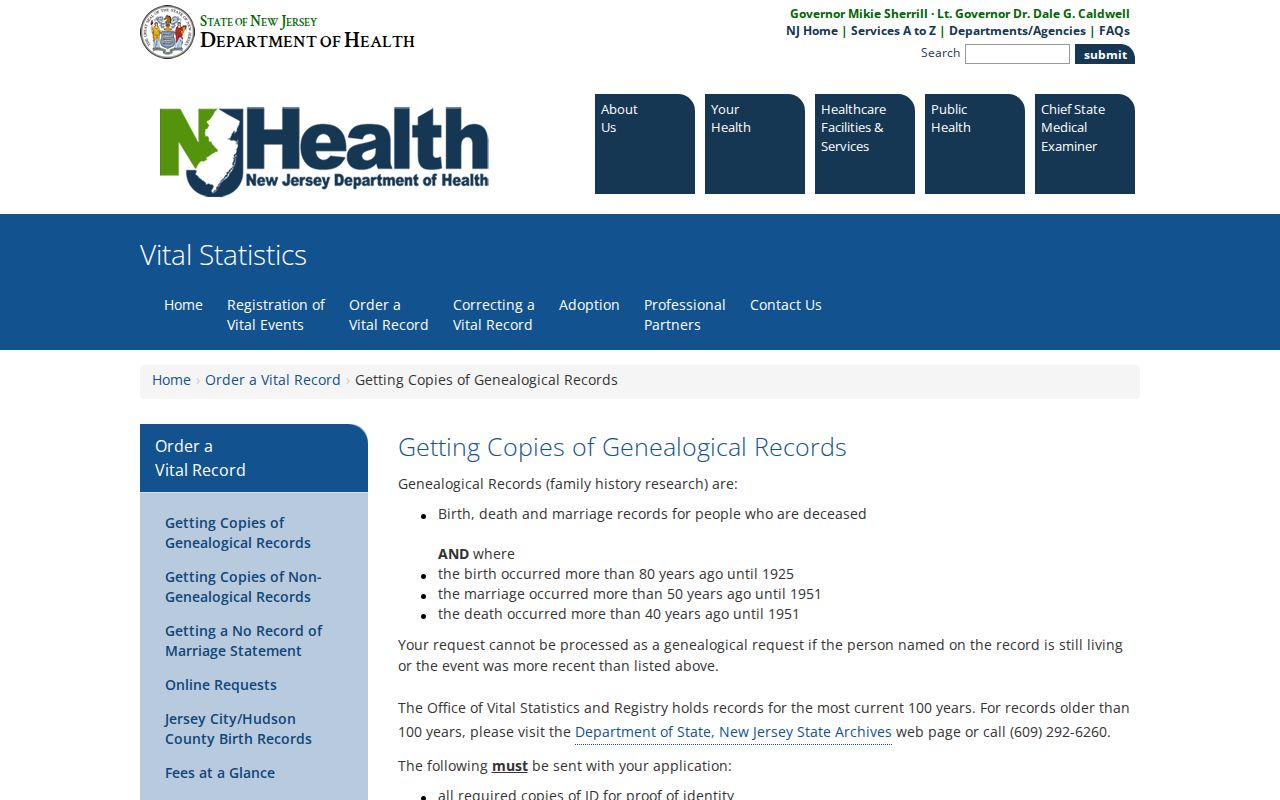
The state lists a $25 fee for the first genealogy copy, $2 for each additional copy of the same record, $1 for each additional genealogy-search year, and $25 for an additional name or county search. Payment and delivery instructions should be checked before mailing. East Brunswick’s local registrar keeps original local birth, death, marriage, civil-union, and domestic-partnership records and lists $10 per certified copy with ID required. The local and state channels serve different series and eligibility situations.
Older Middlesex research can need a different chain. Registration began in New Jersey on May 1, 1848, the early county ledger runs through May 1878, and certificates begin in June 1878. Use the State Archives, local custodians, church, newspaper, cemetery, probate, and land sources as appropriate instead of assuming one modern office holds every early record.
East Brunswick Record Privacy Rules
Missing data can be a privacy rule, not a failed search. Daniel’s Law permits covered people to seek redaction or nondisclosure of home addresses and unpublished phone numbers in state, county, and municipal web material. The law applies to qualifying judicial officers, prosecutors, law-enforcement officers, and certain household family members. A county parcel layer or voter-related record can therefore omit an address even when an underlying government file exists.
The New Jersey Address Confidentiality Program gives eligible survivors and qualifying reproductive-health patients or providers a legal substitute address and mail forwarding. Government agencies must accept that substitute address as the legal address of record. It does not erase an address that was already public. Other record limits can protect Social Security numbers, victim details, medical information, minors, sealed case material, and motor-vehicle data.
When a privacy-protected result is incomplete, do not try to reconstruct the protected detail from scattered sources. Record the source, access date, and stated restriction, then seek help from the correct office if an authorized request is needed.
Note: A protected address or redacted identifier should be treated as intentionally unavailable, not as a gap to be published elsewhere.
East Brunswick Registry Limits
Current-custody and registry tools have narrow purposes. Middlesex County’s adult-inmate lookup is described as a current adult-inmate resource, and its warning prohibits intimidation, harassment, or threats. State custody, county custody, federal custody, parole, and release do not all appear in the same system. A current locator is not a complete life history and does not establish guilt or a final case outcome.
The New Jersey State Police registry identifies its public scope and misuse limits.
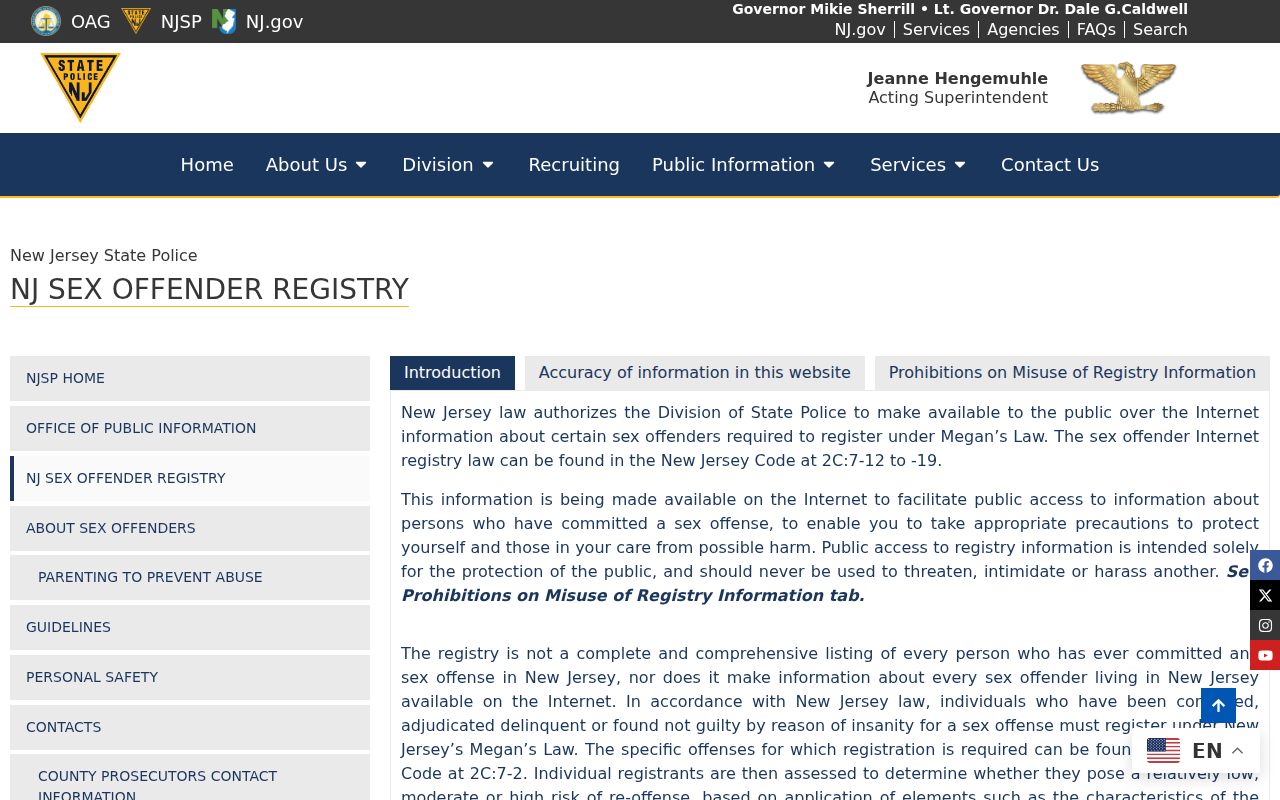
The public internet registry covers specified Tier 3 and Tier 2 registrants, subject to statutory exceptions; Tier 1 is generally not public. It is not a general criminal-history search. Follow the source’s legal-use restrictions, do not contact or target a listed person, and use law enforcement for a safety concern.
Historical East Brunswick Residents Directory Sources
Older East Brunswick household work is usually regional. New Brunswick was the county-seat commercial center, and an older township address can appear under New Brunswick, a postal place, a rural route, or a nearby community. The State Library catalog documents useful New Brunswick and regional directory runs from 1855 through 1981. Its holdings include early volumes in 1855, 1870, 1886, 1890, 1897, and 1899; regional runs from 1901 through 1908; later volumes through the 1920s, 1930s and 1940s; and later runs from 1954 to 1981.
An ordinary directory is arranged by surname. A criss-cross directory reverses the approach by starting with a street address and pointing toward an occupant or household. Record the year, spelling, street suffix, rural-route label, and page reference, then compare that entry with a deed, census geography, probate, or newspaper. A directory says someone was listed at a place in a publication year. It does not alone prove ownership or continuous residence.
The complete historical shelf is treated in the East Brunswick city directory. For a direct research visit, confirm the State Library, Rutgers, East Brunswick Public Library, and museum holdings before assuming a particular volume is on a local shelf.
East Brunswick’s Appleby-DeVoe Record Story
Appleby-DeVoe provides an unusually clear East Brunswick record trail. The DeVoe property was presented to the township in 1945 and opened as a library in 1946. It later operated as an East Brunswick Public Library branch from 1966 to 1981, then became a museum-run local-history reference library and archive under a 1999 lease. That change in stewardship explains why a household search may move from a current library gateway to a former library building with historical collections.
The Appleby-DeVoe Library holds local photographs, family and property material, Governor Hoffman correspondence, and Lindbergh-trial transcripts. Museum material can add context to a home, name, industry, or neighborhood. Ask for the item’s provenance, date, creator, and collection reference before using a caption as evidence. A photograph of a property does not prove ownership, and a family story should remain distinct from a certified deed abstract.
East Brunswick’s former sections also matter. The township incorporated in 1860, and Helmetta, South River, Spotswood, and Milltown withdrew during the 1870 to 1908 period. Preserve the place label in the original record. A modern address-normalization tool can help locate it, but it should not silently replace the historical wording.
East Brunswick Record Depth by Numbers
The gap between online access and record depth is striking. Middlesex online deed coverage begins in 1929, while the locality guide identifies deed indexes from 1784 to 1922 and deed series from 1784 to 1901. Mortgage series are reported from 1766 to 1861, with indexes from 1766 to 1922. The county states that land records on file reach to 1683. These numbers do not mean every early item is indexed in the same way. They show why a portal result is the first stage of an East Brunswick historical search, not the last.
County digitization reported public deeds back into the 1920s, while older bound books remained part of the public-search-room route and the project continued. The records path changes with the date: online index first for the modern range, then the Clerk’s record room or copy channel, followed by county or State Archives material when the date predates convenient online coverage. Keep the date range visible in research notes so a later reader can see why a source changed.
Note: An older series may contain a name or land reference without supplying the same searchable fields available in a current online index.
East Brunswick Written Record Requests
New Jersey’s Open Public Records Act, N.J.S.A. 47:1A-1 et seq., is a route for defined government records that are not posted online. Send the request to the custodian that maintains the record. Describe East Brunswick or Middlesex County, the record type, a date range, known name or parcel identifier, desired format, and a maximum fee. A clear plain-paper request can be used in some circumstances, though an agency may require its official form under applicable rules.
The Government Records Council says a custodian must respond as soon as possible and no later than seven business days, subject to lawful extension. Commercial-purpose or Daniel’s Law review can allow up to fourteen business days with early notice. Electronic records are generally free except for actual storage medium or special service; ordinary paper-copy guidance lists $0.05 per letter or legal-size page and $0.07 per legal-size page, with special-service charges or deposits possible. Approval does not override vital-record eligibility, protected addresses, confidential court material, victim information, juvenile records, or other exemptions.
Use the New Jersey model OPRA request form as a field checklist. A focused request is more useful than asking a custodian to find every record about a person.
East Brunswick Fraud-Alert Checks
Middlesex County offers a free Property Alert service that can monitor a party name or a legal property description using municipality, block, and lot. It is a monitoring aid after a parcel has been confirmed, not a promise that every bad filing will be stopped. The County’s May 2026 fraud campaign highlighted property fraud, cryptocurrency, imposter and phishing, and repair scams. Urgency, unusual payment requests, unfamiliar links, and imitation seals are warning signs.
Verify a deed-copy letter or property notice through the official County Property Alert route and the County Clerk, not the phone number or link printed on an unsolicited notice. For suspected recording fraud, the county lists 732-745-3364 and 732-745-3365; consumer-fraud assistance is listed at 732-398-2300. Preserve the notice, source URL, access date, and any payment request before reporting it.